






Nature Journal
 |
| I
heard the beautiful song of a wood thrush near the house this afternoon.
And there are so many other things that I'd like to tell you about. However, my nature writing has come to an end for now. I look forward to the time when I can begin again. |
 |
| Thursday, July 22, 2004 |
| The
birds are quieting down now that we're into
the summer. Still hear some birds in the mornings, but there's not
too much singing in the afternoons - especially on hot days. My "local" doe and her fawn(s) are being pretty secretive this year. Spotted the doe yesterday for a few moments, but that was the first time since July 5th. Over the past few weeks, I've been seeing the tracks and scat of a red fox. No sightings, though. |
| Sunday, July 18, 2004 |
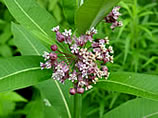 The
Yellow Wood-Sorrel, the Common Cattail, and one species of goldenrod
have started blooming. The
Yellow Wood-Sorrel, the Common Cattail, and one species of goldenrod
have started blooming.Wildflowers that are still in bloom include the Common Milkweed (see photo), Oxeye Daisy, Yarrow, Purple-flowering Raspberry, Black- |
 eyed
Susan, Common Cinquefoil, eyed
Susan, Common Cinquefoil,Red Clover, and White Clover. |
| Wednesday, July 14, 2004 |
| Yesterday
afternoon, I was hearing the begging calls of young barred owls. My
guess is that they were already flying on their own, since the sounds
came from different trees. A little later, some blue jays started
making alarm calls. It stopped for a while, then started again in
earnest. I looked out the window and saw an adult barred owl flying away from the general area where I'd seen it last Thursday. It was pursued by about 5 or 6 blue jays. There might have been other birds in there, but they flew by in a blur and all I heard was "jay, jay, jay,..." This time the barred owl was clutching something that looked larger than what it had found during the last successful foraging trip I had witnessed. Based on the fact that the blue jays were the main (or only) birds in pursuit, I'd have to suspect that it was a nestling or fledgling blue jay. Some time later, I again heard the begging calls of fledging barred owls. Guess that meal didn't satisfy them for long! |
| Saturday, July 10, 2004 |
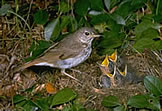 I
was woken up early this morning by the song of a hermit
thrush. They have such a beautiful, ethereal song! I often hear
this bird in the deeper woods, but rarely see or hear it near the
house. I
was woken up early this morning by the song of a hermit
thrush. They have such a beautiful, ethereal song! I often hear
this bird in the deeper woods, but rarely see or hear it near the
house. |
 I
went back to sleep and woke up a I
went back to sleep and woke up alittle while later to the song of a phoebe. Other birds were singing by that time, but the phoebe was playing the role of the soloist. |
| Wednesday, July 7, 2004 |
|
I've
seen a couple of wild turkeys recently
- on separate occasions. They hadn't been around for a while. At
least one of them was a female, but with no brood in tow. |
| Sunday, July 4, 2004 |
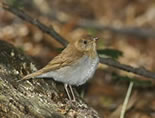 Recently
I was walking though a small grassy area in the woods, when suddenly
a bird flew up out of the grass at my feet. It was a Veery
and it was fast! I might have stepped right on that little bird if
it hadn't flown. Recently
I was walking though a small grassy area in the woods, when suddenly
a bird flew up out of the grass at my feet. It was a Veery
and it was fast! I might have stepped right on that little bird if
it hadn't flown. |
 I
looked down and saw a small nest concealed in the grass. It was lined
with I
looked down and saw a small nest concealed in the grass. It was lined
withwhat looked like thin strips of bark and held 4 bluish eggs. After taking a few moments to observe the nest, I moved away. If I can find a way to go back without disturbing the Veery, I'd love to see the nestlings when they hatch. Maybe I can find a spot at a distance where I can watch without being noticed. |
| Thursday, July 1, 2004 |
|
Two
days ago, I heard alarm calls from some woodpeckers nearby. By the
calls, I'd guess they were hairy woodpeckers. |
| Monday, June 28, 2004 |
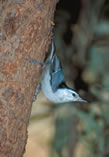 This
is the time of the year when we begin to see adult birds with their
fledglings. A few mornings ago, I saw several young white-breasted
nuthatches on the trunk of a tree outside my window. Their parents
must have been close by, but I didn't catch sight of them. This
is the time of the year when we begin to see adult birds with their
fledglings. A few mornings ago, I saw several young white-breasted
nuthatches on the trunk of a tree outside my window. Their parents
must have been close by, but I didn't catch sight of them.And the adult and juvenile robins have been busily feeding on the ground. The young |
 birds
can be identified by the spots on their breast. birds
can be identified by the spots on their breast.Over the past few weeks, more wildflowers have blooming including the Purple-flowering Raspberry and the Black-eyed Susan. The flowers just started opening yesterday on the Common Milkweed. |
| Top of page |
|
|
| Birds | Butterflies | Mammals |
| Garden Shop |
New England:
Connecticut, Maine, Massachusetts, New Hampshire, Rhode Island, Vermont